
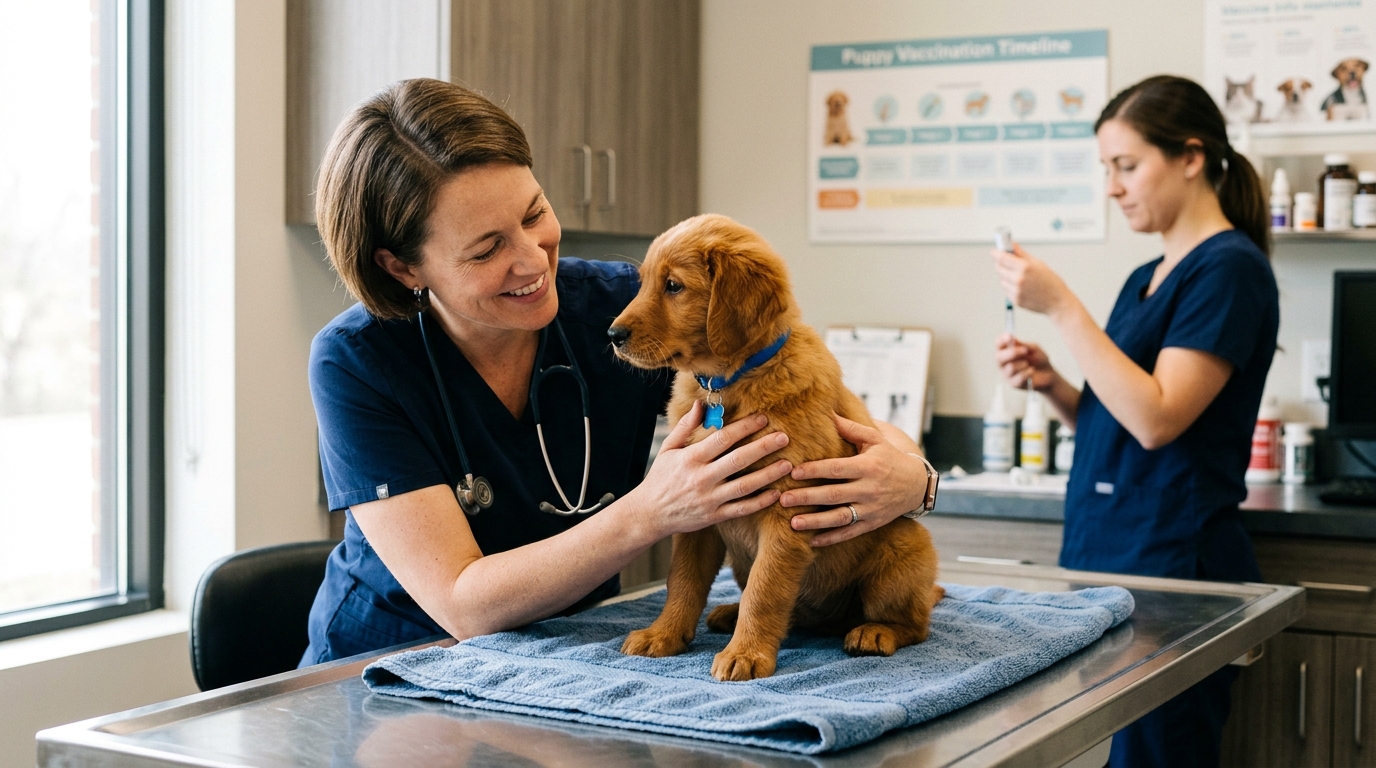
A new puppy comes home with a lot of questions attached, and the vaccine schedule tends to be the most confusing one. Which shots matter, how many rounds are there, and why can’t it all happen in one visit? If you are searching for a veterinarian near me to start your puppy’s shots, this guide from Pacific Veterinary Hospital walks through the full timeline by age, explains core and lifestyle vaccines, covers what California law says about rabies, and shows what adult dogs need once the puppy series is done.
Why Puppies Need a Series of Shots Instead of One
Puppies are born with some borrowed protection. Antibodies from the mother’s milk help guard them in the first weeks of life, but those antibodies fade on an unpredictable timeline. Some puppies lose them at 6 weeks. Others still carry them at 14 or 16 weeks.
Here is the catch. While maternal antibodies are still present, they can block a vaccine from working, and there is no simple way to know the week a puppy’s borrowed immunity drops off. So veterinarians give a series of doses a few weeks apart, each one another chance to catch the moment the puppy’s own immune system can respond.
That gap between fading maternal protection and full vaccine protection is when puppies are most exposed. It is also why parvo shows up so often in young dogs that have had one shot but not the full series. Knowing the early parvo symptoms, such as vomiting, bloody diarrhea, and sudden lethargy, helps you act fast if something goes wrong before the series is complete.
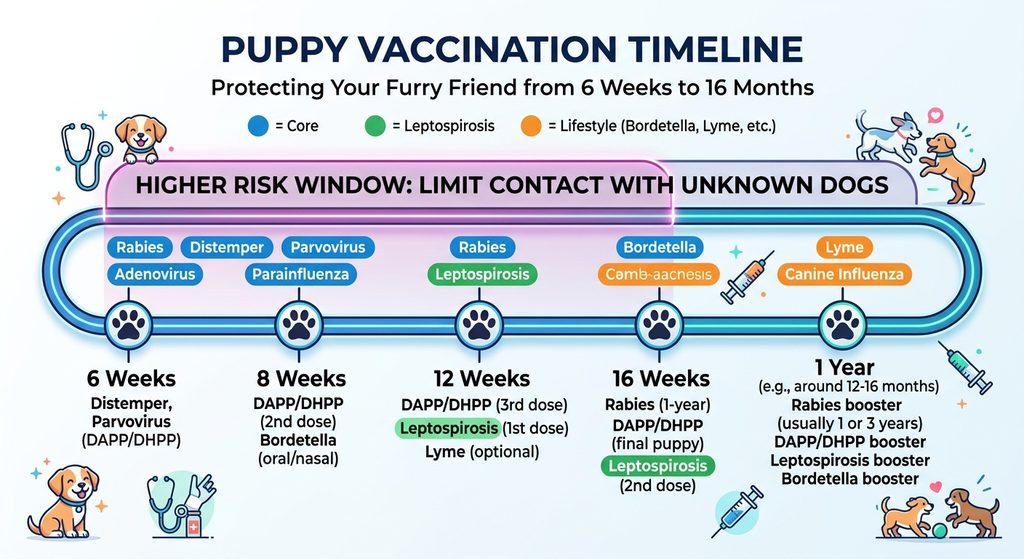
Puppy Vaccination Schedule at a Glance
The table below reflects the general pattern recommended by the American Animal Hospital Association and California rabies rules. Your veterinarian may adjust it based on your puppy’s age at adoption, health history, and lifestyle.
| Puppy Age | Vaccines Usually Given | Notes |
|---|---|---|
| 6 to 8 weeks | DHPP (first dose) | Often started by the breeder or shelter; bring any records you have |
| 10 to 12 weeks | DHPP (second dose) | Bordetella may be added if your puppy will meet other dogs |
| 12 to 14 weeks | DHPP (third dose), leptospirosis (first dose) | Lepto needs two initial doses spaced 2 to 4 weeks apart |
| 14 to 16 weeks | Rabies, leptospirosis (second dose) | California requires rabies for dogs over 3 months of age |
| 16 weeks or older | Final DHPP dose | The final dose should not be given before 16 weeks |
| 12 to 16 months | DHPP, rabies, and lepto boosters | First booster falls about one year after the puppy series |
Core Dog Vaccines Every Puppy Needs
Core vaccines are recommended for every dog, regardless of breed, size, or lifestyle. They protect against diseases that are widespread, severe, or transmissible to people.
DHPP: Distemper, Hepatitis, Parvovirus, and Parainfluenza
DHPP is one combination injection that covers four diseases. Distemper attacks the respiratory, digestive, and nervous systems. Canine adenovirus causes infectious hepatitis. Parainfluenza contributes to respiratory illness. Parvovirus is the one Stockton families hear about most, because it spreads easily through contaminated soil, shoes, and kennels, and it can survive in the environment for months.
Puppies typically receive DHPP every 2 to 4 weeks from about 6 to 8 weeks of age, with a final dose at 16 weeks or older. If a puppy does get sick, early parvo treatment in Stockton gives the best chance of recovery, but prevention is far easier on the puppy and the family.
Rabies Shot for Dogs
Rabies is fatal once symptoms appear, and it can pass to people. That is why the rabies shot for dogs is required by law in California. State rules require dogs over 3 months of age to be vaccinated. According to the California Department of Public Health rabies vaccine compendium, the first booster is due one year after the initial dose, and later boosters follow every three years when a 3-year approved vaccine is used.
Proof of rabies vaccination also matters for licensing. The City of Stockton pet license requirements state that a pet must be current on rabies to receive a license. Keep your rabies certificate somewhere easy to find.
Leptospirosis: Now Considered Core
Leptospirosis is a bacterial infection spread through the urine of infected wildlife, rodents, and other dogs. It survives in puddles, damp soil, irrigation runoff, and standing water, all of which are common around the Delta and local parks after rain. It can damage the kidneys and liver, and people can catch it too.
For years, lepto was treated as a lifestyle vaccine. That changed when the American Animal Hospital Association updated its canine vaccination guidance in 2024 to recommend leptospirosis as a core vaccine for all dogs. The initial series is two doses given 2 to 4 weeks apart, followed by a booster within a year and then annual boosters.
Lifestyle Vaccines: Matching Shots to How Your Dog Lives
Lifestyle vaccines, also called non-core vaccines, are recommended based on where your dog goes and who they spend time with. Your veterinarian will ask about boarding, grooming, daycare, dog parks, hiking, and travel before recommending them.
Bordetella (kennel cough). Bordetella bronchiseptica is one of the main causes of kennel cough. Most boarding facilities, groomers, and daycares require it. It comes in intranasal, oral, and injectable forms, and is usually boosted once a year. Check the facility’s own requirement before booking.
Canine influenza. Dog flu spreads quickly where dogs gather in close quarters. The vaccine requires two initial doses given 2 to 4 weeks apart, then annual boosters.
Lyme disease. Lyme is carried by ticks. It is less common in the Central Valley, but dogs that hike or camp in tick habitat may benefit. Tick prevention remains the first line of defense either way.
| Feature | Core Vaccines | Lifestyle Vaccines |
|---|---|---|
| Who needs them | Every dog | Dogs with specific exposure risks |
| Examples | DHPP, rabies, leptospirosis | Bordetella, canine influenza, Lyme |
| Legal requirement | Rabies required in California | None, though facilities may require them |
| Typical adult interval | DHPP and rabies every 3 years, lepto yearly | Usually yearly |
| How the decision is made | Standard for all dogs | Based on lifestyle, travel, and local risk |
Adult Dog Vaccinations and Booster Timing
Once the puppy series is complete, the schedule becomes much simpler. Using the AAHA core and noncore canine vaccine recommendations as the framework, most adult dogs follow this pattern after their first-year boosters:
- DHPP: every 3 years
- Rabies: every 3 years with a California-approved 3-year vaccine
- Leptospirosis: every year
- Bordetella, canine influenza, Lyme: usually every year, if recommended
The simplest way to stay on track is to pair boosters with a yearly pet wellness exam in Stockton, CA, where your veterinarian can catch early health changes and confirm which vaccines are actually due that year.
What to Expect at Your Puppy’s Vaccine Visit
Before the visit. Bring any paperwork from the breeder, shelter, or rescue, plus a fresh stool sample if you can, since intestinal parasites are very common in young puppies.
During the visit. Your veterinarian performs a nose-to-tail exam before any vaccine is given. Most puppies barely notice the injection, especially with a few treats on hand. This is also a good time to discuss deworming, flea and tick control, heartworm prevention, and microchipping.
After the visit. Mild tiredness, a small decrease in appetite, or a tender spot at the injection site for a day or two is normal. A small, firm lump where the shot was given can appear and usually fades within a few weeks. Let the team know if a lump grows or lasts longer than a month.
Vaccine Reactions: Normal vs When to Call
Serious reactions are uncommon, but every owner should know what they look like. Most happen within minutes to a few hours after the injection.
| Normal After Vaccination | Contact a Vet Right Away |
|---|---|
| Sleepier than usual for a day | Swelling of the face, muzzle, or around the eyes |
| Mild soreness at the injection site | Hives or widespread itching |
| Slightly reduced appetite | Repeated vomiting or diarrhea |
| Mild sneezing after an intranasal vaccine | Trouble breathing, collapse, or pale gums |
If you see anything in the right column, search for an emergency vet near me or call us directly. Let the team know about any past reaction before the next round of shots so they can plan ahead.
Missed a Booster or Adopted a Dog With No Records?
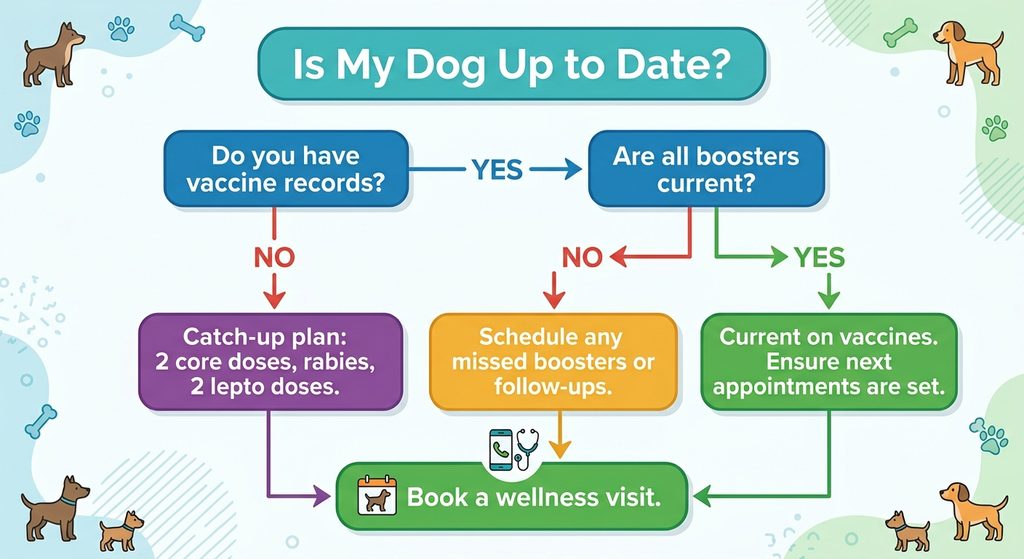
A booster gets missed, or you adopt an adult dog with no vaccine history at all. Neither situation is a crisis. A short catch-up plan solves it.
Puppies who fell behind. If the gap between DHPP doses stretched past a few weeks, your veterinarian may add a dose to make sure the series ends at or after 16 weeks.
Adult dogs with unknown history. AAHA guidance for dogs over 16 weeks with no records is two doses of the core combination vaccine 2 to 4 weeks apart, a rabies vaccine, and two doses of leptospirosis, followed by first-year boosters.
Patient Story: Getting a Late Start Back on Track
This story is a composite based on situations our team sees often. Names and details have been changed.
Maya brought home Biscuit, a 10-week-old Labrador mix, from a neighbor’s backyard litter. The only record was a handwritten note listing a single dose at 6 weeks, and Maya planned to take him to a busy local park that weekend.
At his first visit, our veterinarian explained that one early dose was not enough to protect against parvo, especially in a puppy that young. Together they built a catch-up plan: DHPP at 10, 13, and 16 weeks, rabies at 16 weeks, and two leptospirosis doses because Maya’s backyard flooded every winter. Bordetella was added before Biscuit’s first group training class.
Maya skipped the park until the series was finished and set up playdates with friends’ fully vaccinated dogs instead. Biscuit completed every dose with no reaction beyond one sleepy afternoon, and at his one-year visit he moved to the simpler adult schedule. The plan worked because his records were reviewed early and adjusted to his real history.
Choosing a Vaccination Clinic for Dogs in Stockton
When you search for dog vaccinations near me, puppy shots near me, or dog shots near me, the closest option is not always the most complete one. A full-service vaccination clinic for dogs offers a few advantages:
- A physical exam before every vaccine, so a sick puppy is not vaccinated at the wrong time
- Records kept in one place, with reminders when boosters are due
- Vaccines chosen for your dog’s actual lifestyle rather than a one-size approach
- Access to diagnostics and treatment if a puppy shows signs of illness during the series
- Advice on next steps, such as timing a visit with a spay and neuter clinic in Stockton once your puppy is old enough
Our team handles pet vaccinations in Stockton, CA for puppies, adult dogs, and cats, and builds each schedule around the individual pet. Vaccines are one part of a bigger plan, and our guide to preventive pet care in Stockton, CA covers parasites, dental health, and other everyday steps that keep dogs healthy between visits.
If you are looking for puppy vaccinations near me in north Stockton, you can book a visit for puppy vaccines near me and bring any records you have.
Frequently Asked Questions
-
When should my puppy get the first round of shots?
Most puppies receive their first DHPP vaccine between 6 and 8 weeks of age. Many breeders and shelters give this first dose before adoption, so bring every record you receive. After that, boosters continue every 2 to 4 weeks until your puppy is at least 16 weeks old. If you are not sure whether your puppy has had any shots, your veterinarian can build a safe catch-up schedule at the first visit.
-
How many rounds of puppy vaccines are needed?
Most puppies need three to four rounds of DHPP, depending on how early the series starts. The final dose must be given at 16 weeks or older, since maternal antibodies can block earlier doses. Rabies is added once your puppy is over 3 months old, and leptospirosis requires two initial doses. A full set of dog vaccines in the first year typically takes four or five visits spaced a few weeks apart.
-
Is the rabies shot for dogs required in Stockton?
Yes. California law requires dogs over 3 months old to be vaccinated against rabies, and the City of Stockton requires current rabies vaccination for a pet license. The first rabies vaccine is followed by a booster one year later, then every three years with a state-approved 3-year vaccine. If you need a dog rabies vaccine near me, keep the signed certificate from your vet, since groomers and boarding facilities often ask for it.
-
Can my puppy go outside before finishing the vaccine series?
Your puppy can spend time in your own yard and meet healthy, fully vaccinated dogs you know. Avoid dog parks, pet store floors, rest stops, and any spot where unknown dogs gather until about two weeks after the final DHPP dose. Parvo can live in soil for months, so high-traffic areas carry real risk. Ask your veterinarian about puppy classes, since many accept puppies partway through the series with vaccine proof.
-
Can humans get parvo from dogs that are not vaccinated?
Canine parvovirus does not infect people. Humans have their own parvovirus, which is a different virus. Still, other diseases covered by dog vaccinations, including rabies and leptospirosis, can pass from dogs to people, which is one more reason to keep your dog current. We explain the full answer to can humans get parvo from dogs in a separate guide on parvo and people, including how to clean your home after an infected pet.
-
Do adult dogs need vaccines every year?
Not every vaccine is yearly. After the first-year boosters, DHPP and rabies are usually given every three years. Leptospirosis is given every year, and lifestyle vaccines like Bordetella and canine influenza are typically yearly as well. Your dog should still have a yearly exam, since that visit is when your veterinarian confirms which dog vaccinations are due and checks for health problems that are easier to treat when caught early.
-
What should I do if my dog misses a booster?
Call your veterinarian and schedule the missed vaccine as soon as possible. For a short delay, a single dose usually gets your dog back on track. For a longer gap or unknown history, your veterinarian may recommend restarting part of the series. Rabies boosters follow California rules, so your veterinarian will confirm when the next one is due. Bring any old records so the team can plan accurately.
Pacific Veterinary Hospital, 6828 Pacific Avenue, Stockton, CA 95207. Call (209) 474-2444 to schedule your puppy’s vaccines.
