
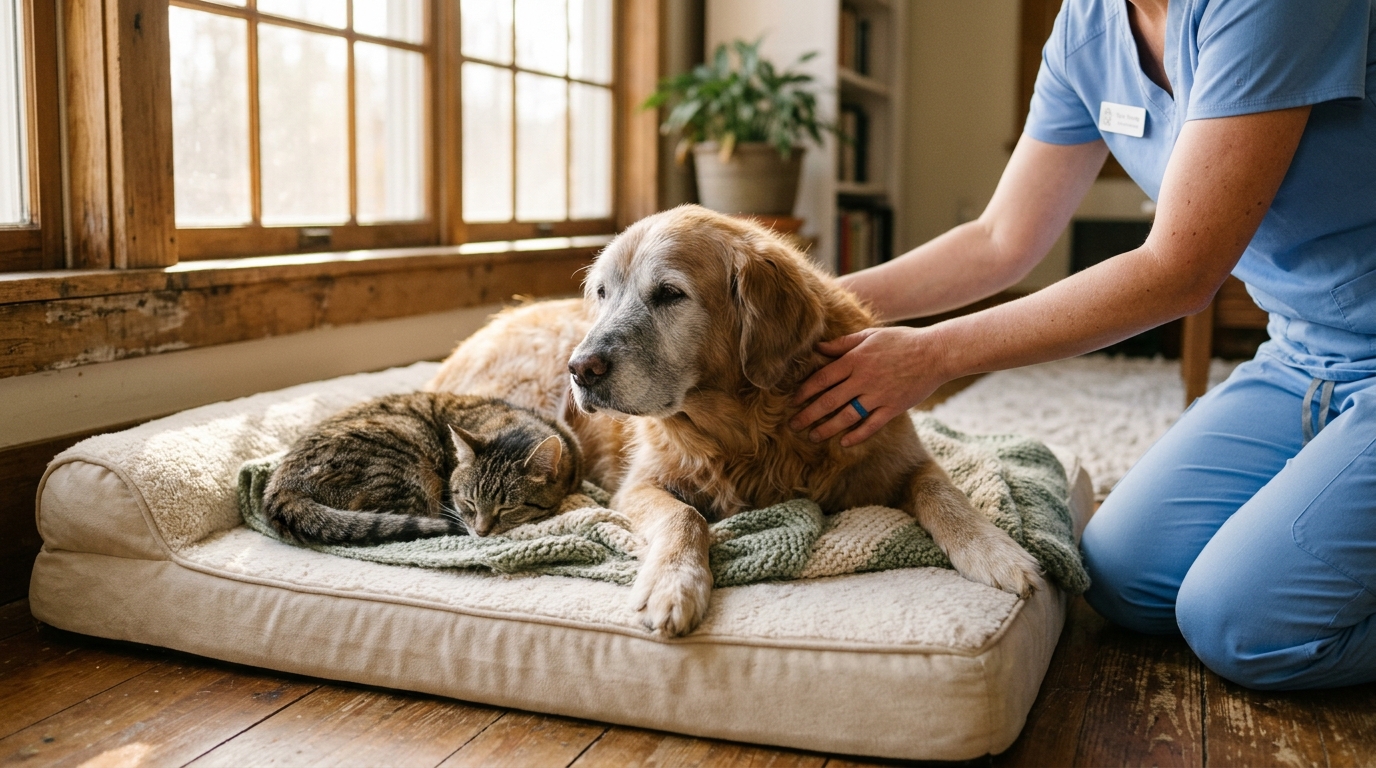
Veterinary hospice care is a plan that keeps a seriously ill dog or cat comfortable, calm and close to family once a cure is no longer the goal. Many Stockton families start with a quick search for a vet near me right after a hard diagnosis, unsure what comes next. This guide explains what pet hospice includes, how to judge quality of life at home, how hospice for dogs differs from hospice for cats, and what pet end of life services look like when the time comes.
What Is Veterinary Hospice Care?
Hospice for animals is a plan of care, not a building. Your pet stays home in a familiar bed with familiar people, while the veterinary team manages pain, nausea, appetite, mobility and anxiety through planned rechecks and medication changes. The AAHA/IAAHPC End-of-Life Care Guidelines sum up the aim: more comfort, less suffering, and a shared plan between the veterinarian and the family.
Hospice care vs palliative care
Palliative care relieves symptoms at any stage of illness, even while a pet is still receiving treatment meant to cure. Pet hospice care begins when you and your veterinarian agree that curative treatment is no longer the plan, or is no longer helping. The goal moves from adding time to making the remaining time good.
Choosing hospice is not giving up
Many owners worry that hospice means they stopped fighting. In practice, it is a more focused fight. Every medication, bed and ramp has one job: making today a better day for your pet.
Conditions where hospice care for animals helps most
- Advanced cancers such as lymphoma, bone cancer, splenic tumors and oral tumors
- End-stage kidney disease, especially common in older cats
- Congestive heart failure that no longer responds well to medication
- Severe arthritis or degenerative spinal disease that limits walking
- Cognitive dysfunction in senior dogs and cats
- Liver failure and other organ disease where treatment has stopped working
Signs Your Dog or Cat May Benefit From Pet Hospice
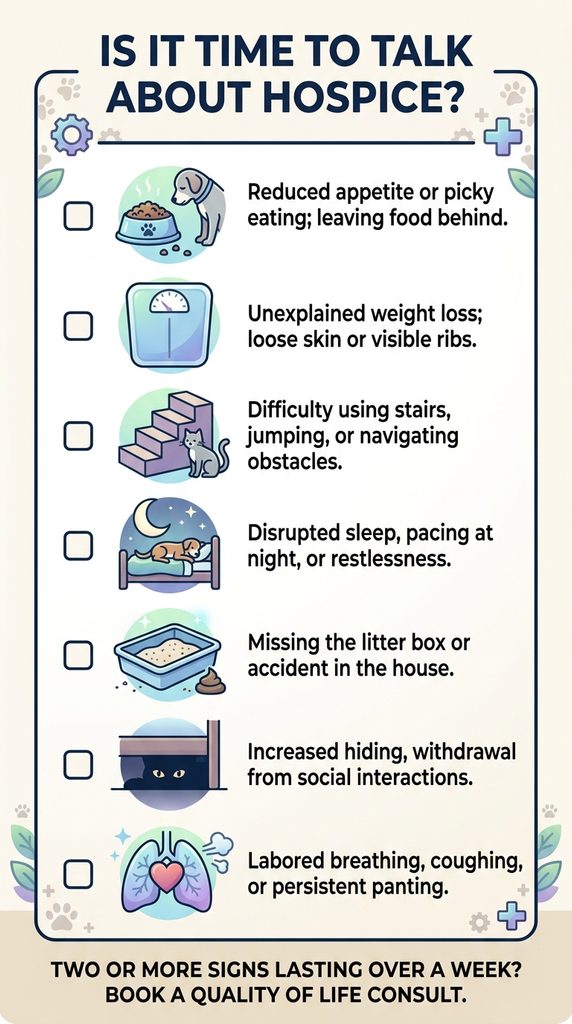
Decline is rarely a single moment. It usually shows up as a pattern of small changes over a few weeks. Watch for:
- Eating less, skipping meals, or only eating when hand fed
- Visible muscle loss along the spine, hips and back legs
- Struggling to stand, slipping on floors, or refusing stairs
- Panting or pacing at rest, especially at night
- Accidents in the house or missing the litter box
- Hiding, sleeping far more than usual, or avoiding family
- Repeated vomiting, coughing or labored breathing
Cats are especially good at hiding pain, so changes in grooming, posture and sleeping spots often tell you more than vocal signs. Our guide to early signs of illness in cats covers the subtle cues many owners miss.
Hospice vs Palliative Care vs Euthanasia: Comparing Your Options
Families often hear all three terms in the same conversation. This table shows how they fit together.
| Option | Main Goal | When It Fits | Where It Happens | Typical Length |
|---|---|---|---|---|
| Palliative care | Relieve symptoms | Any stage, alongside treatment | Home and clinic | Weeks to years |
| Pet hospice care | Comfort when cure is no longer the goal | Terminal or end-stage illness | Mostly at home with clinic rechecks | Days to months |
| Hospice-supported natural death | Peaceful passing with symptoms controlled | When the family chooses not to euthanize and suffering can be prevented | Home | Final days |
| Humane euthanasia | A gentle, pain-free passing | When comfort can no longer be maintained | Clinic, by arrangement | One planned visit |
The AAHA guideline task force considers both euthanasia and hospice-supported natural death medically and ethically acceptable when the choice is made together with the care team. Our veterinarians will always tell you honestly if a natural death would mean distress your pet cannot be spared.
What Pet Hospice Care Includes at Pacific Veterinary Hospital
Every plan is written down and built around one pet, one family and one diagnosis. Families looking for pet hospice care near me usually begin with a quality of life consultation, where we review the diagnosis, the home setup and how much daily care is realistic.
Pain Management
Pain control is the foundation of veterinary hospice care. Most pets do best with a multimodal plan, meaning several medications that work in different ways at lower doses. That can include anti-inflammatories when kidney values allow, gabapentin for chronic pain, stronger relievers for cancer pain, and monthly antibody injections approved for arthritis pain in dogs and cats. Most prescriptions can be filled the same day through our in-house pet pharmacy in Stockton, CA, which makes dose changes quick.
Appetite, Hydration and Nausea Control
Nausea quietly ruins appetite, so anti-nausea medication often comes before appetite stimulants. Cats with kidney disease frequently benefit from fluids given under the skin at home, and our team will teach you how to do it calmly. Warmed food, strong-smelling options and small frequent meals all help.
Mobility and Home Comfort
Simple changes prevent falls and pressure sores: orthopedic beds, rugs over slick floors, support harnesses, ramps instead of stairs, raised bowls for dogs and low-entry litter boxes for cats. Keep food, water and the bed close together, and block stairs and pool areas for pets with weak legs.
Diagnostics That Guide Comfort Decisions
Hospice does not mean guessing. Periodic in-house bloodwork tracks kidney values, anemia and liver function so medications stay safe. A pet ultrasound in Stockton, CA can show fluid building up in the chest or belly, which can sometimes be drained to ease breathing.
Scheduled Quality of Life Check-Ins
Rechecks usually run every one to four weeks and become more frequent as a pet declines. They work a lot like a senior pet wellness exam in Stockton, CA, except the focus moves from prevention to comfort: weight, pain score, hydration, mobility and your notes from home.
Hospice for Dogs vs Hospice for Cats: Key Differences
Dogs and cats show decline in different ways, so their hospice plans look different too.
| Factor | Hospice for Dogs | Hospice for Cats |
|---|---|---|
| How pain shows | Panting, restlessness, limping, reluctance to walk | Hiding, hunched posture, poor grooming, sitting very still |
| Common hospice conditions | Cancer, arthritis, heart failure, spinal disease | Kidney disease, cancer, hyperthyroid complications, heart disease |
| Appetite support | Hand feeding, warmed meals, appetite stimulants | Strong-smelling food, appetite gels on the ear, small frequent meals |
| Mobility aids | Harnesses, ramps, non-slip flooring | Low-entry litter box, steps to favorite perches, heated beds |
| Giving medication | Usually easy with treats or pill pockets | Often easier as liquids, gels or injections |
| Home setup | Bed near family activity, easy outdoor access | Quiet, warm space with food, water and litter close together |
How to Measure Your Pet’s Quality of Life at Home
Quality of life is hard to measure because pets cannot tell us how they feel. A 2022 scoping review of quality of life tools for dogs and cats screened 82 publications and found only nine general tools suitable for these species, none fully validated. The most common items were activity level, desire to interact and appetite, with mood and grooming adding value for cats.
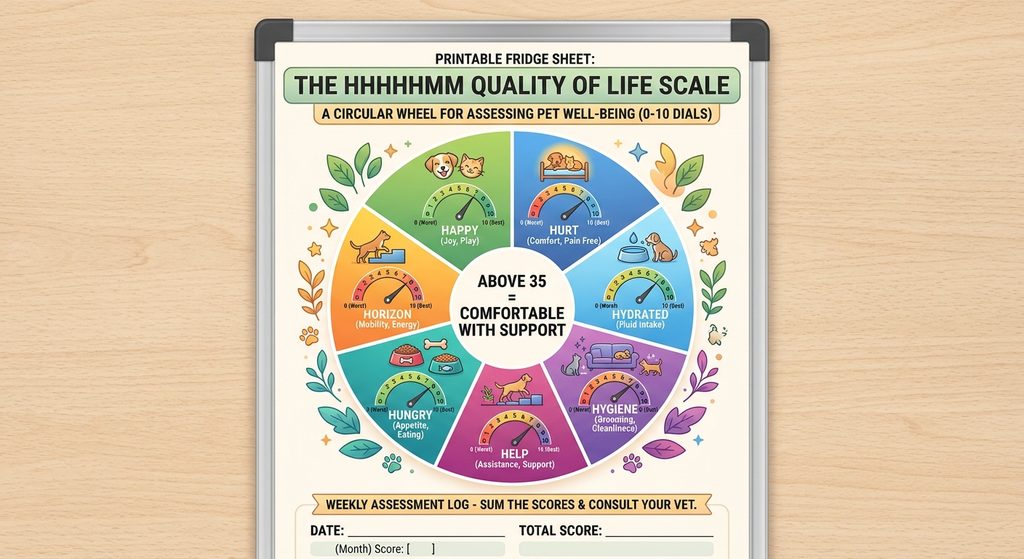
That is why we pair a simple scale with your daily observations. Many veterinarians use the HHHHHMM scale developed by veterinary oncologist Dr. Alice Villalobos. Score each category from 0 to 10.
| Category | What to Ask Yourself | Score (0 to 10) |
|---|---|---|
| Hurt | Is pain controlled? Is breathing comfortable? | |
| Hunger | Is my pet eating enough, with or without help? | |
| Hydration | Is my pet drinking, or receiving fluids, enough? | |
| Hygiene | Can my pet stay clean, especially after accidents? | |
| Happiness | Does my pet still respond to family, toys or treats? | |
| Mobility | Can my pet get up and reach food and litter? | |
| More good days than bad | Do good days still outnumber bad ones this week? |
A total above 35 generally suggests acceptable quality of life with hospice support. Lower scores, or a sharp weekly drop, mean it is time to call us.
The good day and bad day calendar
Keep a calendar on the fridge and mark each day as good or bad. When bad days outnumber good ones over a full week, it is time for a conversation, even if no single day felt like a crisis.
Case Study: How a Hospice Plan Typically Evolves
The example below is a composite built from common clinical patterns and does not describe any individual patient. It shows how a plan for a 13-year-old large-breed dog with severe arthritis and early kidney disease usually changes over about two months.
| Phase | What the Family Notices | How the Plan Changes |
|---|---|---|
| Weeks 1 to 2 | Slow to rise, slipping on floors, eating normally | Pain plan started, rugs laid down, harness fitted, baseline bloodwork |
| Weeks 3 to 5 | Better mobility, short walks again, occasional skipped breakfast | Doses adjusted, anti-nausea medication added, score in the high 40s |
| Weeks 6 to 8 | More bad days, weight loss, restless nights | Kidney values rising, fluids and appetite support added, score nears 35 |
| Final days | Refuses food, cannot stand without help | Family chooses a planned, peaceful euthanasia with everyone present |
The value here is not only the extra weeks. The family saw the decline coming, made decisions calmly and said goodbye on a planned day instead of in an emergency room at midnight.
When Hospice Care Moves Toward Euthanasia
A good hospice plan talks about euthanasia early, before it is urgent, so you already know your options when the day comes. The AVMA’s guidance on humane end-of-life care stresses clear communication with families and respectful handling of a pet’s remains.
At Pacific Veterinary Hospital, a sedative is given first so your pet falls into a deep, relaxed sleep, and only then is the final injection given. Family members are welcome to stay. If you have been researching pet euthanasia in Stockton, CA, or asking about at-home pet euthanasia, ask our team which setting suits your pet.
Planning also protects you. A co-chair of the AAHA guideline task force noted that around 30 percent of owners experience significant grief after losing a pet, and about half doubt their decision after euthanasia. A plan made in calm moments makes that doubt less likely.
If your pet declines suddenly with collapse, severe breathing trouble or uncontrolled pain, do not wait for the next recheck. Call us or come in for urgent pet care in Stockton, CA.
Aftercare and End-of-Life Pet Services in Stockton
Deciding on aftercare ahead of time spares you from choices in the hardest hour. Our team coordinates with local cremation providers, so families searching for pet cremation in Stockton or dog cremation in Stockton can arrange everything with one call.
| Aftercare Option | What Happens | Good Fit For |
|---|---|---|
| Private cremation | Your pet is cremated individually and the ashes are returned | Families who want to keep or scatter ashes |
| Communal cremation | Pets are cremated together; ashes are not returned | Families who prefer a simple, respectful option |
| Home burial preparation | Your pet is prepared for burial where local rules allow | Families with suitable private land |
| Keepsakes | Paw prints and fur clippings, on request | Anyone who wants a lasting memento |
We can also share information on local pet cemeteries and memorials. Ask about these end of life services for pets during your hospice consultation, not afterward.
Grief Support for Your Family
Grief often starts before a pet passes. This anticipatory grief is normal. Let children say goodbye and use plain words like “died” rather than “went to sleep,” which can confuse younger kids. Other pets may act unsettled for a while, so keep their routines steady.
Free, confidential help is available. The Cornell Pet Loss Support Hotline is staffed by trained veterinary students, and our team can share the ASPCA Pet Loss Hotline and local support groups.
Why Stockton Families Choose Pacific Veterinary Hospital for End-of-Life Care
- Serving Stockton pets since 1981
- A 4.3-star Google rating from local pet owners
- In-house bloodwork, X-ray, ultrasound and pharmacy, so hospice plans change quickly
- Care in English and Spanish
- New patients welcome without a referral
If your dog or cat has received a difficult diagnosis, you do not need every answer before calling. Book a same day vet appointment in Stockton, CA for a quality of life consultation, and we will build a comfort plan with you.
Frequently Asked Questions About Veterinary Hospice Care
-
What is the difference between pet hospice and euthanasia?
Pet hospice is ongoing comfort care for a pet with a terminal or end-stage illness. It controls pain, nausea, appetite and mobility so your pet can live well at home for the time that remains. Euthanasia is a single, planned procedure that ends life gently when comfort can no longer be maintained. Many families use both, starting with hospice and choosing euthanasia once quality of life scores show the good days have run out.
-
How long can a dog or cat stay in hospice care?
There is no fixed limit. Some pets stay comfortable in hospice for a few days, while others do well for several months, depending on the illness and how well symptoms respond to treatment. Pets with slow-moving conditions such as arthritis or kidney disease often have longer hospice periods than pets with aggressive cancers. Weekly quality of life scoring helps you and your veterinarian see when the plan needs to change.
-
Is there dog hospice near me in Stockton?
Yes. Pacific Veterinary Hospital on Pacific Avenue in north Stockton offers hospice and end-of-life care for dogs and cats. Families from Stockton, Lodi, Manteca and nearby San Joaquin County communities come to us for pain management, quality of life consultations, in-house diagnostics and planned euthanasia. Your dog stays home between rechecks while our team adjusts medications as needs change. Call (209) 474-2444 to schedule a hospice consultation.
-
Can cats receive hospice care at home?
Yes, and most cats do better at home than anywhere else. Feline hospice usually focuses on pain control, anti-nausea medication, appetite support and fluids given under the skin, which many owners learn to give in a few minutes. Cats prefer a warm, quiet space with food, water and a low-entry litter box close by. Because cats hide discomfort well, watch grooming, posture and appetite closely and report changes early.
-
How can I tell if my pet is in pain during hospice?
Dogs in pain often pant at rest, pace, limp, avoid stairs or become restless at night. Cats tend to hide, sit hunched, stop grooming, squint or lose interest in food. Changes in sleep, appetite and how your pet greets you are also important clues. Keep a short daily log and score quality of life weekly. If you notice new pain signs, call us, because doses can usually be adjusted the same day.
-
Will my pet suffer if we choose a natural death?
Not necessarily, but it requires close planning. A hospice-supported natural death means pain, breathing difficulty, anxiety and nausea are actively managed until the end. Without that support, a natural death can involve distress that is hard to watch and hard to control at home. Our veterinarians will talk honestly with you about whether a natural passing can stay comfortable for your pet, or whether euthanasia would be kinder.
-
What end of life pet services do you offer after a pet passes?
We coordinate private cremation with ashes returned, communal cremation, and preparation for home burial where local rules allow. Paw prints and fur clippings are available on request as keepsakes. Our team also shares information on local pet cemeteries, memorial options and pet loss support resources. We recommend choosing aftercare during your hospice consultation, so you are not making decisions in the hardest moment and everything is ready when your family needs it.
Pacific Veterinary Hospital, 6828 Pacific Avenue, Stockton, CA 95207. Call (209) 474-2444 to talk with our team about veterinary hospice care for your dog or cat.
